Weaving New Neural Pathways: Fibre Arts for Mental Health

It is no secret that creative craft practices increase well-being - fibre craft communities around the world have known this for centuries, which is likely why some of these ancient techniques continue to be used today. Fibre-based practices like weaving, spinning, knitting, crochet, etc. are inherently meditative, often requiring considerable mental focus to create something we feel proud of. Every crafter knows the pain of unweaving or frogging a section made while distracted!
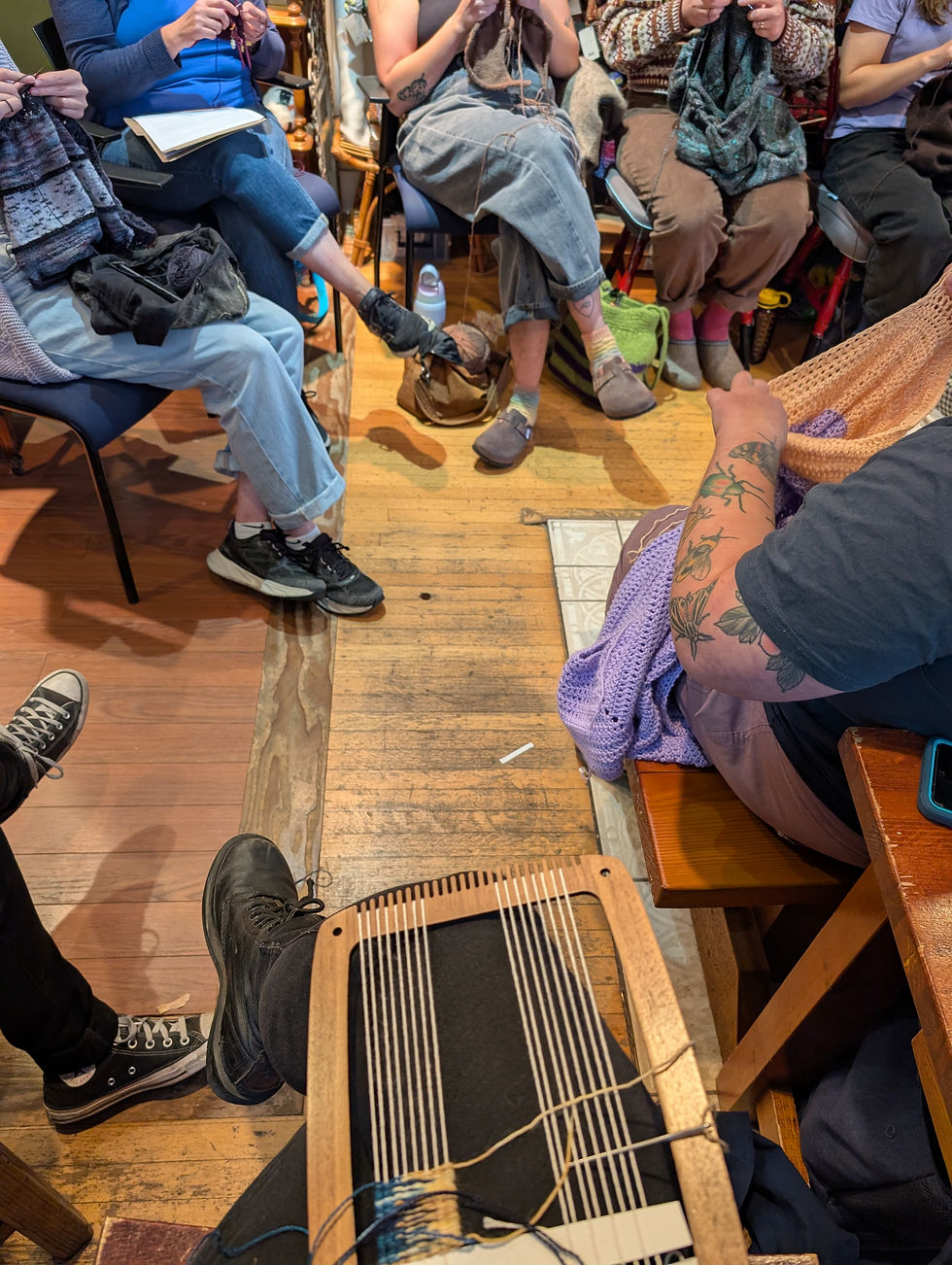
Contemporary research is catching up to knowledge held within community, solidifying the mental health benefits of crafting. Multiple studies report that engaging in creative practices like textile crafts increase overall life satisfaction and happiness while significantly decreasing anxiety. Engaging in craft practices in group settings, such as knitting circles or social craft nights, has the added benefit of reducing loneliness.
Since the introduction of major social media platforms in the early 2000s, we have found ourselves spending more and more time online. This has been great for the fibre world in many ways: we created community with other crafters all over the world, our access to hand-dyed yarn & fibre is better than ever, and the exposure of craft practices on social media attracted many new people to join the community. Twenty years later, we are also seeing some negative mental health impacts of excessive social media use and a new wave of slow craft practice is emerging as the antidote.
Most people know about the benefits of knitting and crochet, but we found tragically few sources on two of our favourite crafts: spinning and weaving. Both practices have been around for several millennia, with fossilized imprints of spun and woven flax fibres (linen) dating back to 72,000 years ago, and archeological examples of woven fabric have been found all over the world. Most of us likely have at least one ancestor who spun or wove.

As enthusiastic contemporary weavers and spinners, we know firsthand that both crafts can be beneficial, mindful practices. Spinning often requires full engagement of the body and brain to create an even, high-quality yarn, which can prevent rumination and reduce overall anxiety. With rigid heddle or multi-shaft weaving, the benefits are progressive: when you are new to rigid heddle, you must be fully focused on the flow of the shuttle through the shed if you want a straight, even edge, and as you become more practiced, the gentle glide of the shuttle can become almost trance-like, leading to deep states of calm. Both spinning and rigid heddle use elements of creativity, like aesthetically pleasing colour combinations and textures, but it is in tapestry weaving that craft and art truly marry, combining the creative benefits of visual art with the tactile, meditative benefits of fibre craft.

This is why we teach drop spinning, wheel spinning*, rigid heddle weaving, and tapestry weaving here at Knotty by Nature: we want you to experience the same mental health benefits that make our daily lives feel so much more fulfilled. We know that many of our customers are shopping as locally as possible, so we carry everything you need to get started on your creative fibre journey. Knotty visitors also tell us all the time that being in our store full of fluffy rainbows is healing all by itself, so we welcome folks to come in for a demonstration. We're excited to share our passion with you!
*Wheel spinning classes are available one-on-one by request. Please e-mail us to schedule a lesson.


বুনন শিল্পের মাধ্যমে মানসিক প্রশান্তি খুঁজে পাওয়ার এই দারুণ নিবন্ধটি পড়ে খুব ভালো লাগল। সৃজনশীল কাজ যে আমাদের মস্তিষ্কের স্বাস্থ্যের জন্য কতটা উপকারী তা সত্যিই চমৎকার। bc game apk (
I came across this while searching for some fresh wording ideas:
https://novynypoltavy.com/angela-ohoronczya-tobi-ideyi-najkrashhyh-pryvitan-prozovi-slova-ta-virshi/
Some of the suggestions are quite easy to personalize.
Just leaving it here in case anyone needs something similar.
Саморобне рішення реальне для простих схем, але має обмеження: у станціях біологічного очищення параметри подачі повітря задані виробником, і відхилення від них порушує роботу мулу. Розбір, Як зробити аератор для септика, з деталями й обмеженнями є за посиланням. Обладнання в такому середовищі має бути захищене від вологи й агресивних газів, і на цьому економити не варто.
Mình có lần lướt đọc mấy trao đổi trên mạng شيخ روحاني thì thấy nhắc nên cũng tò mò mở ra xem thử cho biết. Mình không tìm hiểu sâu جلب الحبيب chỉ xem qua trong thời gian ngắn để quan sát bố cục جلب الحبيب cách sắp xếp شيخ روحاني các mục và trình bày nội شيخ روحاني dung tổng thể. Cảm giác là các phần được trình bày khá gọn, các Berlinintim mục rõ ràng nên đọc lướt cũng không bị rối جلب الحبيب với mình như Berlinintim vậy là đủ để nắm tin cơ bản rồi. جلب الحبيب
,
,
Часом знаходжу ці джерела випадково, іноді хтось скине в чат, іноді сам зберігаю “на потім”. Частину переглядаю рідко, частину — коли шукаю щось локальне чи нестандартне. Вони різні: новини, огляди, думки, регіональні стрічки. Я не беру все за правду — скоріше, для порівняння та пошуку контрасту між подачею. Можливо, хтось іще знайде серед них щось цікаве або принаймні нове. Головне — мати з чого обирати. Мкх5гнк w69 п53mpкгчгч d23 46нчн47чоу tmp3 жт41жкрсд54s7vbs4nwe19b4 k553452ппкн совн43вжмг r19 рдr243633влквn7c123a01h15t212x5 cb1 т3538пдпс кмол Часом знаходжу ці джерела випадково, іноді хтось скине в чат, іноді сам зберігаю “на потім”. Частину переглядаю рідко, частину — коли шукаю щось локальне чи нестандартне. Вони різні: новини, огляди, думки, регіональні стрічки. Я не беру все за правду —…